Backpack Safety for Colchester Kids: A Chiropractor's Guide
Weight limits, strap position, packing order, and the warning signs most parents walk right past.
By Dr. Christine Lebiecki, D.C. · September 15, 2021
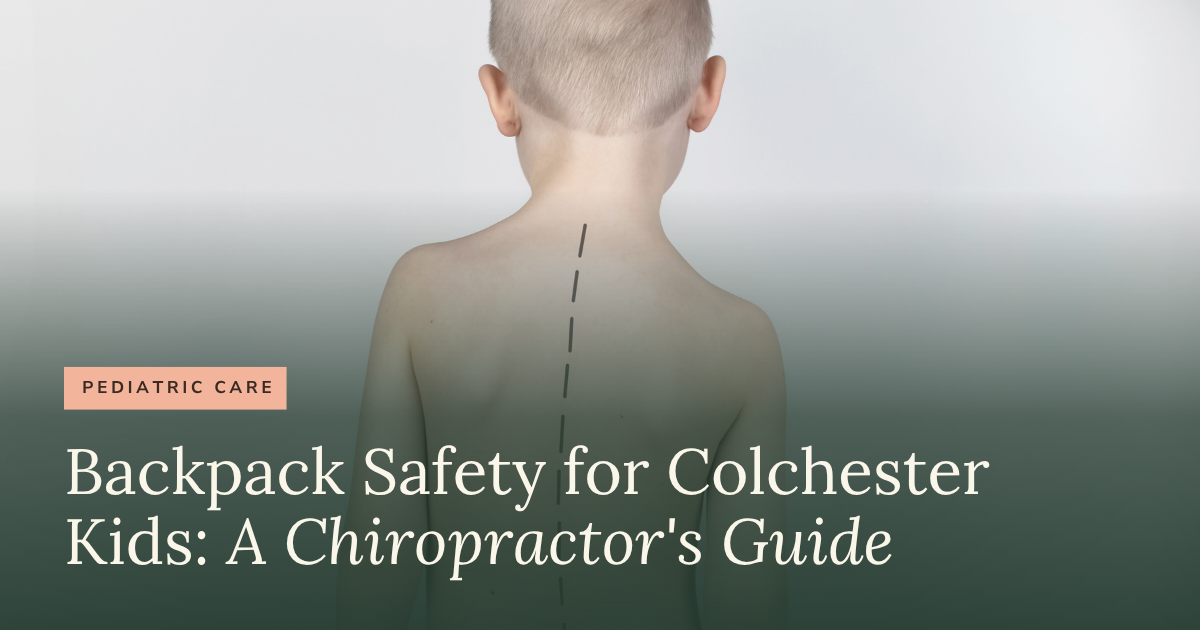
Watch your child walk away from you toward the school door. If their head juts forward, if one shoulder rides higher than the other, if they lean into the sidewalk like they are walking uphill, the backpack is too heavy.
Kids will not tell you. They will carry what they are handed and they will adapt around it, because that is what growing bodies do. The adapting is the problem.
The Number That Matters: 10 to 15 Percent
A loaded backpack should weigh no more than ten to fifteen percent of your child's body weight. Ten is the better target for younger or smaller children.
Because nobody does that math in a hallway, here it is already done.
A 50 pound child: 5 to 7 pounds.
A 70 pound child: 7 to 10 pounds.
A 90 pound child: 9 to 13 pounds.
A 120 pound child: 12 to 18 pounds.
Put the packed bag on a bathroom scale on a Monday morning. Most parents are genuinely surprised. A single hardcover textbook with a water bottle and a Chromebook will blow past the limit for a second grader without anyone noticing.
Pack It Heaviest-Closest-to-the-Spine
Weight that sits away from the body acts like a lever. The further out it sits, the harder your child's back muscles have to pull to keep them upright.
Load heaviest items, textbooks, laptop, in the compartment closest to their back. Medium items next. Light and soft items, jacket, snack, in the outer pocket. Fill side pockets evenly so the load is balanced left to right rather than all on one side.
Then take things out. The most effective backpack intervention is not a better bag, it is fewer items in the bag. Ask what actually needs to travel each day and what can live in a locker or at home.
Straps: Both of Them, Snug, and Use the Waist Belt
One strap over one shoulder is the single most common thing I see, and it is the hardest habit to break because it looks better to a middle schooler than the alternative. It also loads the entire pack onto one side of the spine and one set of shoulder and neck muscles.
Both straps. Always.
Adjust them so the pack sits against the upper and middle back, with the bottom of the bag no lower than the waistline. A pack hanging down near the hips pulls the shoulders backward and the head forward.
Straps should be padded and at least two inches wide. If the bag has a waist or chest strap, use it. It transfers a real share of the load from the shoulders to the pelvis, which is built to carry weight.
Teach your child to bend at the knees to pick the bag up, and not to twist at the waist while wearing it.
What About Rolling Backpacks?
They genuinely help, with conditions.
Rolling bags work well for a child carrying a consistently heavy load on flat ground. They work poorly on stairs, on school buses, in crowded hallways, and in a Colchester February when the sidewalk is snow and salt. A rolling bag that gets carried up a staircase by its top handle is worse for a spine than a well-fitted backpack.
Check with the school first. Some do not allow them. If your child has stairs in their daily route, a properly fitted backpack usually beats a roller.
Warning Signs Worth Paying Attention To
These are the things to actually look for.
A forward head lean or a hunch that appears when the pack goes on. One shoulder consistently higher than the other. Red marks or deep grooves on the shoulders after the pack comes off. Your child struggling or straining to lift the bag, or needing to swing it up with momentum. Complaints of neck, shoulder or back pain at the end of the school day.
And the one that matters most: numbness or tingling in the arms or hands. That points toward nerve or circulatory compression under the straps, and it deserves an evaluation rather than a strap adjustment.
Persistent pain, a visible postural change that does not resolve when the pack is off, or any suspicion of a spinal curve should be looked at properly. Some of those are backpack problems and some are not, and telling the difference is worth an appointment rather than a guess.
The Back-to-School Window
Early fall is the right moment for this. The new bag is still new, the habits are still forming, and nothing has been repeated five days a week for six months yet.
Weigh the bag this week. Watch your child walk away once. If something looks off, or if they have been mentioning their neck since school started, bring them in. At Family First Chiropractic in Colchester, Vermont, I look at growing spines all day, and a fifteen minute check is a small thing next to a habit that has years left to run.
If your child is showing symptoms, contact our team at Family First Chiropractic today.
Or call (802) 860-0382