Fitness and Your Spine: Advice from a Colchester Chiropractor
Most gym back injuries are not bad luck. They are one of about four positions, repeated under load.
By Dr. Christine Lebiecki, D.C. · October 1, 2021
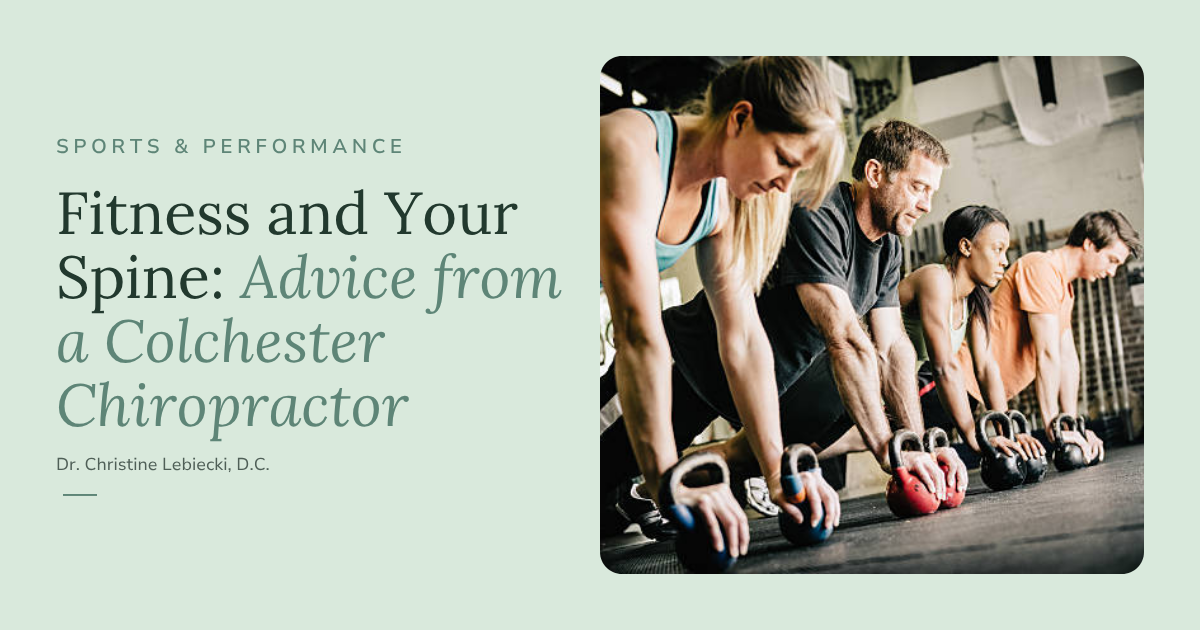
You felt it on the fourth rep. Not a tear, not a pop, just a warm line across your lower back telling you something moved that should not have. You racked the bar and finished the session. Two days later you cannot put your socks on.
Here is what I want you to know first: this almost never means you are fragile, and it almost never means you should stop lifting. The people who get hurt training are rarely the ones lifting too heavy. They are the ones whose spine changed shape at the same point in the same movement, over and over, until tissue complained. That is a mechanics problem, and mechanics problems are fixable.
Bracing Is Not Sucking In Your Stomach
Your lumbar spine is stable when the muscles around it act like a cylinder: abdominals in front, obliques on the sides, deep back muscles behind, diaphragm on top, pelvic floor below. Pressurize that cylinder and your spine has something to resist against. That is bracing.
Most people brace wrong in one of two ways. They pull the belly button in toward the spine, which narrows the cylinder and reduces stiffness. Or they hold a big chest inhale, which pressurizes the ribcage rather than the abdomen and leaves the low back unsupported.
Instead: breathe through your nose into your belly and sides so your waist expands in all directions, then tighten as though you are about to be pushed. Keep ribs stacked over pelvis rather than flared, and hold that through the hard part of the rep.
Hinge or Squat: Choosing Wrong Is Where Back Pain Starts
Almost every lower-body movement is one of two patterns. A hinge is motion at the hips with a fairly vertical shin: deadlift, Romanian deadlift, kettlebell swing. A squat is motion at the hip and knee together with a more upright torso.
The most common fault is squatting a hinge or hinging a squat. People turn a deadlift into a squat by dropping the hips too low at the start, which puts the bar out in front and forces the lower back to make up the difference. Others turn a squat into a hinge by letting the hips shoot back out of the bottom, so the torso folds forward. Both end the same way: the load moves away from your hips and your lumbar spine becomes the lever.
The Three Lifts That Send People to My Office
The deadlift. The fault is lumbar flexion off the floor. The back rounds before the bar moves, and the spine loads flexed. Set the lats, pull the slack out of the bar, and start the pull only once your back is set.
The barbell row. The fault is losing the hinge as you fatigue. The torso rises, the low back extends, and the last reps become a jerk from the lumbar spine. If your torso angle changes rep to rep, the set is over.
The overhead press. The fault is borrowing range from your low back. If your shoulders lack overhead motion, the only way to get the bar overhead is to lean back and extend the lumbar spine, which turns a shoulder exercise into a spinal one.
Your low back is not weak. It is doing a job that belongs to your hips and your shoulders.
Why Overhead Position Deserves Extra Attention
True overhead motion requires the shoulder blade to rotate upward and the thoracic spine to extend. If you sit at a desk in Colchester all week, neither is happening much. Press anyway and your lumbar spine pays the difference.
Test it before you load it. Stand with your back against a wall, ribs down, and raise your arms. If your low back peels off the wall before your hands touch it, that is your answer. Work the mid-back first, then press from a position you own.
When It Is Not a Form Problem
Chiropractic care helps relieve the joint restriction, muscle guarding and pain that follow a training injury, and an assessment tells you which joints are not moving and which are moving too much. It does not replace coaching, and it will not undo a program asking too much of you. How much to lift and how fast to add is covered in training smarter and managing load.
Some symptoms need more than an adjustment: pain with numbness, tingling or weakness down a limb, any loss of bowel or bladder control, pain that wakes you from sleep and does not change with position, or a back injury after a fall or crash. Those warrant proper evaluation, and sometimes imaging or referral.
At Family First Chiropractic in Colchester, Vermont, I would rather see you the week your form starts slipping than the month after something gives. Bring me the back that keeps complaining and let us find the position causing it. Competitive athletes can also read how athletes use chiropractic through a season.
Our team at Family First Chiropractic is here to help. Contact us today.
Or call (802) 860-0382