TMJ and Jaw Pain: How Colchester Chiropractic Can Help
Clicking, aching, locking and the headaches that come with them, and what actually helps.
By Dr. Christine Lebiecki, D.C. · July 1, 2021
You notice it when you yawn. Or biting into a sandwich. A click, a catch, a dull ache under the cheekbone that spreads toward your ear and up the side of your head. Some mornings your jaw feels tired before you have used it, which makes no sense until someone explains what your face was doing all night.
Most people with jaw pain are told there is not much to be done about it. There is.
What the TMJ Is and What Goes Wrong
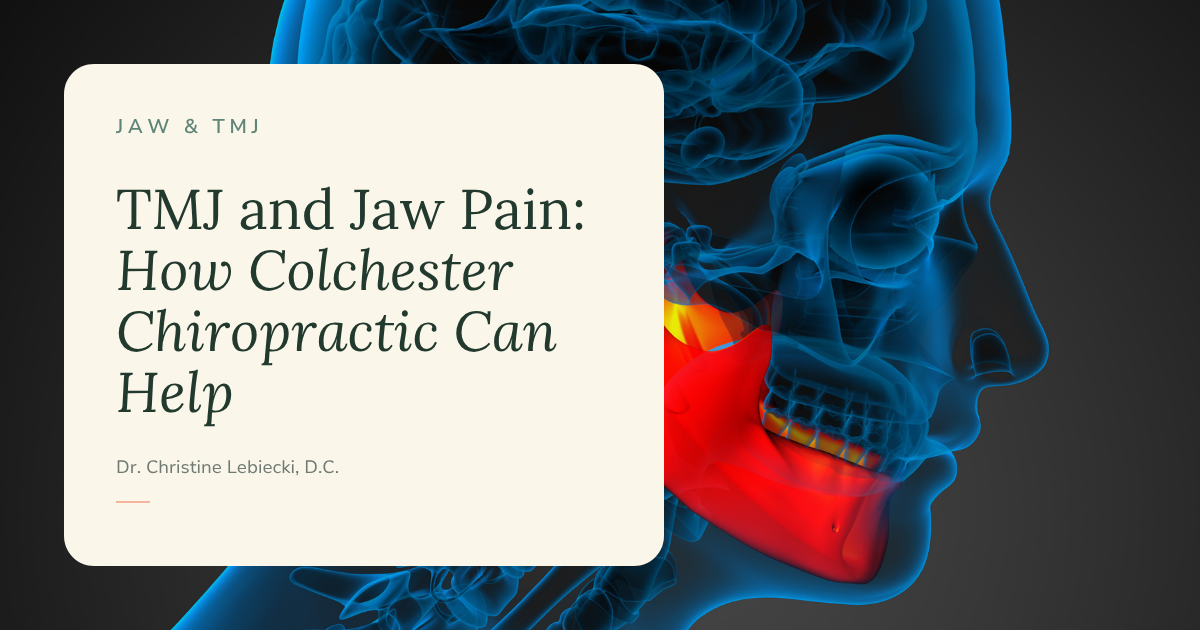
The temporomandibular joint sits just in front of each ear, connecting your lower jaw to your skull. There are two of them and they work in coordination, so you cannot move one without the other. Between the bone surfaces sits a small cartilage disc that has to track smoothly as the joint moves. When that disc shifts, you get the click. When the joint or surrounding muscles get irritated, you get the ache. When things get stuck, the jaw locks.
Common symptoms: pain in the jaw, cheek, teeth or in front of the ear when chewing or yawning; clicking; limited opening; teeth that no longer meet properly; earaches; and headaches through the temples.
Clenching, Grinding and the Muscles Nobody Thinks About
Most TMJ pain is not about the joint alone. It is about the muscles that drive it.
Your masseter is one of the strongest muscles in the body for its size. Add the temporalis fanning across the side of your skull and the pterygoids deeper inside, and you have a group built for sustained force. Those muscles were never meant to be on for eight hours a night.
Bruxism, clenching and grinding, usually happens during sleep, which is why people do not know they do it. The clues are indirect: morning jaw fatigue, worn tooth surfaces your dentist points out, headaches worst on waking.
The Upper Cervical Connection
This is the piece that explains why a chiropractor belongs in this conversation.
The top of your neck and your jaw are mechanically and neurologically linked. Your head position dictates your resting jaw position: let the head drift forward, as most of us do over a keyboard, and both the jaw's resting posture and the path it travels when opening change.
Sensory input from the upper neck and from the jaw also converge on the same region of the brainstem, the trigeminocervical nucleus. That convergence is why neck problems can present as facial pain, and why addressing upper cervical restriction often changes jaw symptoms that local jaw work has not touched.
If headaches are a big part of your picture, it is worth knowing which type of headache you are actually dealing with, because cervicogenic and tension type headaches respond differently than migraine.
Stress, Jaw Tension and the Loop They Create
Jaw clenching is one of the body's default stress behaviors. Under sustained sympathetic activation, the stress mode your nervous system gets stuck in, the jaw braces. It is not a conscious choice.
Then the loop closes. Clenching creates muscle pain. Pain is a stressor. Stress increases clenching. Clenching is worst during shallow, poorly regulated sleep, which is why this rarely resolves with a night guard alone.
A night guard protects your teeth. It does not tell your nervous system it is safe to stop bracing.
How Care Works at Family First Chiropractic
At Family First Chiropractic in Colchester, Vermont, an assessment for jaw pain looks at more than the jaw. I check how the joint tracks as you open and close, where the muscle tenderness sits, and how the upper cervical spine is moving. I ask about sleep and stress.
Care typically combines gentle upper cervical adjusting, soft tissue work to the jaw musculature, and work aimed at helping your nervous system settle out of its bracing pattern. Many patients find the clicking and the headaches shift together, which tells you they were never separate problems.
Working With Your Dentist
Keep your dentist involved. Some TMJ pain is driven by bite alignment, a failing restoration, or tooth pain masquerading as joint pain, and a custom night guard is often the right call. Chiropractic and dental care handle different parts of this. The best results usually come from both.
What You Can Do Between Visits
Rest position: lips together, teeth apart, tongue resting lightly at the roof of your mouth. Your teeth should only touch when you chew or swallow.
Soft food during a flare. Skip the bagels, gum and jerky for a week.
Moist heat on the jaw muscles for ten minutes in the morning.
Watch your screen posture. Every inch your head drifts forward changes what your jaw must do.
Slow exhales, longer out breath than in breath. A direct input to the system doing the clenching.
If Your Jaw Has Been Bothering You for Months
You do not have to keep adapting around it. If your jaw clicks, aches or locks, or you wake with headaches and a tired face, let us look at the jaw and the neck together and find what is driving it.
Schedule a consultation with our team at Family First Chiropractic.
Or call (802) 860-0382