Stretching the Right Way: A Colchester Chiropractor Explains
Static versus dynamic, when each one belongs, and the four mistakes that turn stretching into an injury.
By Dr. Christine Lebiecki, D.C. · May 15, 2021
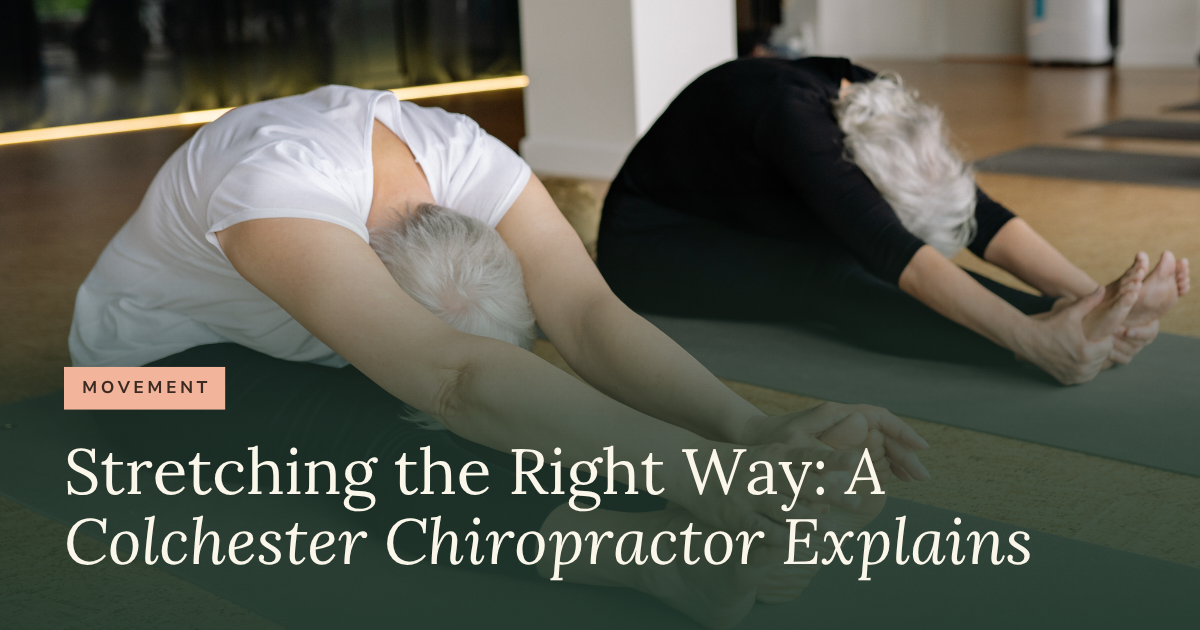
Almost everyone I meet knows they should stretch. Very few know what kind, when, or for how long, so they end up doing the same three stretches they learned in a gym class twenty years ago, holding them for four seconds each, usually right before something that needs their muscles to be springy.
Stretching is genuinely useful. It is also one of the easiest things to do in a way that gives you nothing, or occasionally makes you worse. Here is how I explain it to patients at Family First Chiropractic in Colchester, Vermont.
Static Versus Dynamic, and When Each Belongs
Dynamic stretching means moving a joint through its range repeatedly, under control, without holding at the end. Leg swings, arm circles, walking lunges, hip openers. It raises tissue temperature, wakes up the nervous system, and prepares muscles to produce force.
Static stretching means taking a muscle to a lengthened position and holding it, usually 30 to 60 seconds. It works more slowly, on tolerance and tissue length over time.
The timing rule is simple. Dynamic before activity. Static after activity, or as a separate session when you are already warm. Long static holds immediately before lifting or sprinting temporarily reduce power output, which is the opposite of what you want in the moment. If you are building a training plan around this, training smarter, not just harder covers programming.
If you only ever do one, do static in the evening. Most people are not sprinting. Most people are sitting.
The Four Mistakes That Cause Problems
Bouncing. Pulsing at the end of a stretch triggers a protective reflex that makes the muscle contract against you. You are fighting your own nervous system and risking small tears. Move in slowly and stay still.
Stretching cold. First thing in the morning, straight out of a chair, in a cold garage. Cold tissue is less compliant and you are more likely to push past what it will give. Walk for five minutes first, or do the dynamic version instead.
Stretching an already hypermobile joint. This is the one almost nobody hears. If your joints are naturally very loose, that end-range pull you are chasing is not tightness, it is instability, and the muscles are holding on for a reason. Stretching it further feels great for about twenty minutes and then feels worse. If you can put your palms flat on the floor easily, hyperextend your elbows, or your shoulders have a history of going where they should not, you need strength and control at end range rather than more length.
Stretching through nerve pain. Tight muscle feels like a broad dull pull that eases as you hold. Nerve irritation feels sharp, electric, burning, or comes with tingling or numbness down a limb. Hamstring stretches in particular are often actually pulling on an irritated sciatic nerve. If it zings, stop. That symptom needs an assessment, not more tension.
Tightness is a sensation, not a diagnosis. Sometimes the muscle is short. Sometimes it is guarding something, and stretching it harder just means arguing with your own nervous system.
A Six Move Routine You Can Actually Do
Ten minutes. Do it in the evening, or after a workout. Hold each for 30 to 45 seconds per side and breathe out slowly as you settle in.
1. Half kneeling hip flexor stretch. Kneel on one knee, tuck your tailbone under, shift gently forward. Directly counters sitting.
2. Figure four glute stretch. Lying on your back, ankle across the opposite knee, pull the bottom thigh toward you.
3. Supine hamstring stretch with a strap or towel. On your back, leg up, knee slightly bent. Keeping the knee soft keeps tension off the nerve.
4. Doorway chest stretch. Forearm on the frame, elbow at shoulder height, step through. Opens what desk work closes.
5. Thoracic rotation. Side lying, knees stacked and bent, top arm sweeps open across the body. Follow your hand with your eyes.
6. Levator scapulae stretch. Look down toward your armpit, one hand gently guiding the head, other shoulder pressed down. This is the one for that stubborn spot beside the shoulder blade.
Five days a week beats an occasional heroic session. If your restriction is stiffness in a joint rather than length in a muscle, that is a different problem, and how chiropractic care supports range of motion explains the difference.
Stretching supports flexibility and comfort. It does not fix a joint that is not moving well, and it is not the answer for nerve symptoms. If you have been stretching faithfully in Colchester and something still will not let go, come in and let me find out what is actually holding it.
At Family First Chiropractic our team is here to help. Contact us today.
Or call (802) 860-0382